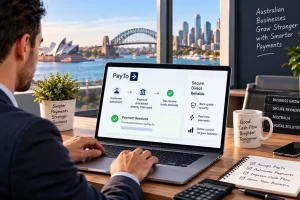
Choosing an online payment provider in Australia isn’t just about finding a way to accept money. It’s about finding a setup that fits how your customers pay today and can keep up with the business you’re building.
This guide covers what to check, what to ask and what has recently changed in Australian payments, so you can decide with confidence.
In short: what should you look for in an online payment provider?
Look for transparent pricing, the payment methods your customers actually use, support for how you sell (one-off, recurring or scheduled), reliable settlement, strong security, integrations with your existing software, responsive support and room to grow. Don’t compare providers on headline transaction fees alone. Compare total cost, customer experience, admin workload and flexibility.
What Is an Online Payment Provider?
An online payment provider is a service that moves money from your customer to your business when they pay digitally.
At its simplest: customer → payment provider → your business.
What happens in the middle is where providers differ. Some focus on card payments at checkout. Others add payment links, invoicing, subscriptions, bank-account payments, reporting, or software integrations. Some are built specifically around payment agreements.
You’ll also hear the term “payment gateway”. A gateway is the technology that securely passes payment details from your website to the payment network. When people search for the best payment gateways in Australia, they’re usually looking for a full provider because the gateway is only one part of the service.
Signs You've Outgrown Your Current Payment Setup
You don’t need to switch providers every year. But it’s worth a fresh look if:
- Your transaction volume has grown and fees are harder to predict
- Customers are asking to pay over time or on a schedule
- Your team is manually chasing payments
- Reconciliation takes hours every week
- Failed payments keep creating admin work
- Your provider doesn’t support the way you sell
- You’re planning new services or new markets
If three or more sound familiar, your payment setup has probably become a constraint rather than a support.
Start With How Your Business Actually Gets Paid
Most comparison guides start with “Does it accept cards?” A better first question is: ‘How does your business actually get paid?’ The answer usually falls into one or more of four patterns.
One-off payments. The customer pays once, in full, like an online order or a single appointment.
Recurring payments. The customer pays at regular intervals for an ongoing service, like a gym membership.
Scheduled payments. The customer agrees to a set series of payments on set dates, such as course fees paid fortnightly.
Flexible payment arrangements. The customer doesn’t pay the full amount upfront and spreads it across an agreed schedule. This is common for higher-value purchases, such as travel bookings.
These are different jobs. A provider that’s excellent at one-off checkout may not handle scheduled collections well.
It also helps to keep the terms separate. Direct debit pulls payments from a customer’s bank account under the authority they’ve signed. A payment agreement sets out what the customer will pay the business and when. Australian Payments Plus, for example, describes a PayTo agreement as one where the customer authorises the amount, purpose and frequency of payments, whether one-off, ad hoc or recurring.
8 Things to Check Before Choosing an Online Payment Provider in Australia
1. Total cost, not just the transaction fee
Headline fees are easy to compare. Total cost is what you actually pay.
Cost | What to check |
Transaction fees | Percentage, fixed fee, or both |
Monthly or platform fees | Ongoing costs regardless of volume |
Setup fees | One-off implementation costs |
Payment method pricing | Whether cards and bank payments are priced differently |
Failed payments | Any dishonour, retry or recovery fees |
Refunds and disputes | Whether fees are returned and what disputes cost |
Integration costs | Development or add-on software you’ll need |
2. The customer experience
Payment is part of your customer journey, not just back-office plumbing. Is it easy on mobile? Does the customer clearly understand what they’re agreeing to, especially for scheduled payments? Can they view and manage their payments? What happens if a payment fails, and who tells them?
3. Payment flexibility
Check that the provider supports the patterns you identified earlier. Look at scheduling options, whether payments can be automatic or customer-initiated, and whether schedules can be adjusted when circumstances change.
4. Room to grow
Don’t choose a payment provider for the business you have today. Choose one that can handle the business you’re building. Will pricing stay sensible if volume doubles? Can you add recurring payments or new payment methods later? Can more staff get access with the right permissions?
5. Settlement and cash flow
How quickly do funds reach your account, and are there holding periods for new businesses? Predictable settlement matters more than most owners realise, until they’re waiting on it.
6. Integrations
Does it connect with your website, booking system and accounting software? Every manual export is a small cost you pay again and again.
7. Security and trust
Ask how customer data is protected, how payments are authorised and which standards the provider meets. For card payments, ask about PCI DSS compliance. You don’t need to be a security expert, but you should get clear, direct answers.
8. Support
When something goes wrong on a Friday afternoon, who do you call? Check support hours, channels and whether the team understands your industry.
A Simple Scorecard to Compare Providers
Whether you’re shortlisting the best payment gateways in Australia or a specialist provider, a weighted scorecard keeps the decision objective. Score each provider from 1 to 5 per category, multiply by the weight, then divide the total by 5 for a score out of 100.
Category | Weight |
Total cost | 20 |
Customer experience | 15 |
Payment flexibility | 15 |
Security and trust | 15 |
Integrations | 10 |
Room to grow | 10 |
Settlement and cash flow | 5 |
Reporting | 5 |
Support | 5 |
Adjust the weights to suit you. A gym might weight recurring payments higher, while a travel business might prioritise flexible scheduling.
How Australia's Payment Landscape Is Changing
A few recent changes make this a good time to review your setup.
Card surcharges have ended on the major networks. Since 1 October 2026, businesses can no longer surcharge eftpos, Mastercard or Visa debit, credit and prepaid card payments, following the Reserve Bank of Australia’s review of merchant card payment costs and surcharging. If you previously passed card costs on through a surcharge, those costs now need to be absorbed or built into your prices. That makes the total cost of your setup more important than ever.
Fee transparency is increasing. The same reforms require card networks and large payment providers to publish more information about their fees, with further changes scheduled for 2027.
Rules continue to evolve, so check the RBA and ACCC for current guidance before changing your pricing.
Where Does Cashwo Fit?
Not every business needs the same type of payment solution. Some mainly need to accept card payments online. Others need recurring billing. Others need something different: a clear, structured way for customers to agree to pay over time.
That’s where Cashwo comes in. It’s an online payment provider in Australia built around payment agreements, so businesses can offer structured payment arrangements instead of treating every sale as pay-now or not at all.
Cashwo supports one-time and recurring payment agreements, with daily, weekly or fortnightly schedules that can be tailored to industry needs. Payments come from the customer’s bank account, either deducted automatically or made by the customer when they choose.
In practice, Cashwo is already part of Mann Travel’s offline booking process, giving customers who can’t pay the full amount at booking a way to spread the cost. The same approach can suit real estate, healthcare, gyms and vehicle rental, where higher-value or regular payments are common.
The Bottom Line
The right online payment provider in Australia is the one that fits how your customers pay, how your team works and where your business is heading.
Start with how you get paid. Compare total cost, not headline fees. And test the customer experience yourself before you commit.
If your customers would benefit from spreading higher-value payments over time, talk to the Cashwo team about how payment agreements could work for your business.
Frequently asked questions
What should I look for in an online payment provider in Australia?
Transparent pricing, the payment methods your customers use, support for how you sell, reliable settlement, strong security, useful integrations and responsive support.
Is the cheapest payment provider always the best?
No. A low transaction fee can be outweighed by monthly fees, failed-payment costs, slow settlement or hours of manual admin. Compare total cost and workload.
What's the difference between recurring payments and payment agreements?
Recurring payments repeat at set intervals, usually for an ongoing service. A payment agreement sets out the terms the customer has agreed to, which can cover one payment, a fixed series of instalments or an ongoing arrangement.
Can I still add a surcharge to card payments in Australia?
Not on eftpos, Mastercard or Visa payments from 1 October 2026. Check the RBA and ACCC for the latest rules on other payment methods.
Can businesses let customers pay over time?
Yes. Options include in-house payment plans, buy now, pay later services and payment agreements. Each works differently, so check who carries the risk, what the customer pays and how payments are collected.